Continuous Presses for Cider
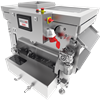
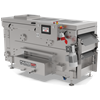
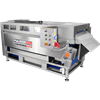
Unlike wine–particularly red and rosé—where the juice sits on the fruit after being crushed, juice for cider should be extracted (via pressing) immediately after the fruit has been milled. Because of this, presses that allow for continuous production have been designed specifically for making cider.
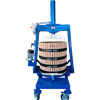
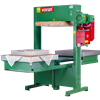
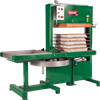
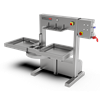
A Packing Press (sometimes called a “rack and cloth” press) has a stationary frame with a carriage that either slides or rotates. At each end of the carriage is a drain basin where the pressing takes place. Milled fruit is spread evenly across the center of a large cloth, then the edges of the cloth are folded over top of it and a thin “rack” (latticed strips of wood, plastic, or stainless-steel) is placed over it. On top of the rack, another cloth is laid and the process is repeated until the stack reaches the desired height. A piston beneath the basin then raises the stack up to a fixed pressing plate and applies increasing pressure, to extract the juice that is layered within the cloths. While the pressing is taking place at one end of the carriage, the rack and cloths are unloaded, cleaned, and reloaded at the other end.
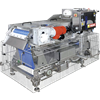
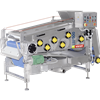
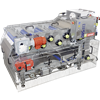
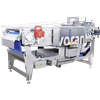
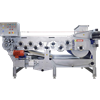
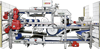
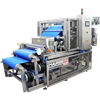
Belt presses have a permeable belt that remains in constant motion, weaving over and under a series of rollers. Milled fruit is spread across the belt as passes beneath the loading hopper. Each roller that the belt runs under puts pressure on the fruit, forcing the juice through the small holes in the belt. The extracted juice is funneled into a collection basin, while the pressed pomace is discarded via a scraper after the belt passes over the last roller in the series. As the belt travels along the bottom of the frame, it is sprayed with water to ensure it’s clean before passing beneath loading hopper. Longer belts allow for more rollers, which increases the production rate and volume, because it decreases the amount of time the fruit has to spend on each pressing roller to achieve the desired yield.
The juice from both a Packing Press and a Belt Press is typically light and crisp, as there is minimal pulp for it to flow through while being extracted.