Cider, Fruit, & Stills
Processing Equipment for Cideries, Olive Oil Producers, and Distilleries
Winemakers Depot has always been focused on offering the best equipment to cidermakers, olive oil producers, and distillers of all sizes. From continuous processing lines for cider, to intelligent stills, to automated olive oil mills; we are proud to have teamed up with some of the most innovative manufacturers in the world to achieve these goals.


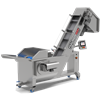
SA200 Washing Elevator with Fruit Mill (1.1 Ton)
On Special:
$14,450.00 ends 6/30/2026
Cider Mills, Olive Oil Mills, and Continuous Presses
Cider Mills, Grinders, and Shredders
The terms Mill, Grinder, and Shredder are often used interchangeably when it comes to equipment used to break down apples and pears for making cider; however, there are distinctions between these machines.
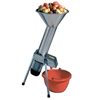
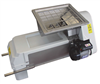
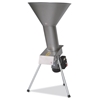
Historically, “mill” referred to the whole system of equipment used to create cider; whereas the “grinder” was the part of that system that turned the fruit into a pulp. Traditionally, this was done with rotating blades and/or crushing rollers (like a grape crusher). More modern / commercial grinders actually use something called a hammer mill, which uses a pair or set of stainless-steel impellers spinning at high speeds to break down the fruit into smaller chunks that are then forced through a cutting screen.
Shredders are almost a combination between the traditional grinder and a hammer mill, often employing a serrated disc (like a saw blade) and knife blades to cut and shred dry or stringy products before they reach the impellers.
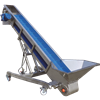
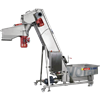
Grinders can either be standalone units or combined with a washing elevator for a continuous production line.
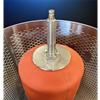
Destoners perform a similar function for stone and pitted fruits, such as cherries, plums, apricots, etc. A destoner contains a long, perforated drum with a central rotating shaft that has at least three silicone “blades” attached to it that run the length of the drum. The blades are adjustable in depth to allow the stone to pass beneath it as the central shift spins the blades inside the drum. The centrifugal force separates the rest of the fruit from the stone, pushing it through the holes in the drum, while the stone rolls out of the end of the drum.
Cider Mills, Grinders, and Shredders
The terms Mill, Grinder, and Shredder are often used interchangeably when it comes to equipment used to break down apples and pears for making cider; however, there are distinctions between these machines.
Historically, “mill” referred to the whole system of equipment used to create cider; whereas the “grinder” was the part of that system that turned the fruit into a pulp. Traditionally, this was done with rotating blades and/or crushing rollers (like a grape crusher). More modern / commercial grinders actually use something called a hammer mill, which uses a pair or set of stainless-steel impellers spinning at high speeds to break down the fruit into smaller chunks that are then forced through a cutting screen.
Shredders are almost a combination between the traditional grinder and a hammer mill, often employing a serrated disc (like a saw blade) and knife blades to cut and shred dry or stringy products before they reach the impellers.
Grinders can either be standalone units or combined with a washing elevator for a continuous production line.
Destoners perform a similar function for stone and pitted fruits, such as cherries, plums, apricots, etc. A destoner contains a long, perforated drum with a central rotating shaft that has at least three silicone “blades” attached to it that run the length of the drum. The blades are adjustable in depth to allow the stone to pass beneath it as the central shift spins the blades inside the drum. The centrifugal force separates the rest of the fruit from the stone, pushing it through the holes in the drum, while the stone rolls out of the end of the drum.
Olive Oil Mills
When referring to olive oil production, the word Mill has traditionally meant all the components involved in the process. The three core components of every production mill are crushing (via a hammer mill), malaxing, and separating the oil from the olive paste; and many smaller setups will incorporate all three into a single, compact unit with a separate elevator that also rinses and defoliates. Higher production mills will have dedicated equipment for performing each function, using multiple elevators, conveyors, and pumps to move product through the entire milling process.
Visit WMD Equipment (our sister company) for more information about processing equipment for Olive Oil.
When referring to olive oil production, the word Mill has traditionally meant all the components involved in the process. The three core components of every production mill are crushing (via a hammer mill), malaxing, and separating the oil from the olive paste; and many smaller setups will incorporate all three into a single, compact unit with a separate elevator that also rinses and defoliates. Higher production mills will have dedicated equipment for performing each function, using multiple elevators, conveyors, and pumps to move product through the entire milling process.
Visit WMD Equipment (our sister company) for more information about processing equipment for Olive Oil.
Cider Presses
Unlike wine–particularly red and rosé—where the juice sits on the fruit after being crushed, juice for cider should be extracted (via pressing) immediately after the fruit has been milled. Because of this, presses that allow for continuous production have been designed specifically for making cider.
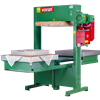
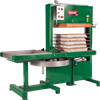
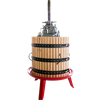
A Packing Press (sometimes called a “rack and cloth” press) has a stationary frame with a carriage that either slides or rotates. At each end of the carriage is a drain basin where the pressing takes place. Milled fruit is spread evenly across the center of a large cloth, then the edges of the cloth are folded over top of it and a thin “rack” (latticed strips of wood, plastic, or stainless-steel) is placed over it. On top of the rack, another cloth is laid and the process is repeated until the stack reaches the desired height. A piston beneath the basin then raises the stack up to a fixed pressing plate and applies increasing pressure, to extract the juice that is layered within the cloths. While the pressing is taking place at one end of the carriage, the rack and cloths are unloaded, cleaned, and reloaded at the other end.
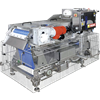
Belt presses have a permeable belt that remains in constant motion, weaving over and under a series of rollers. Milled fruit is spread across the belt as passes beneath the loading hopper. Each roller that the belt runs under puts pressure on the fruit, forcing the juice through the small holes in the belt. The extracted juice is funneled into a collection basin, while the pressed pomace is discarded via a scraper after the belt passes over the last roller in the series. As the belt travels along the bottom of the frame, it is sprayed with water to ensure it’s clean before passing beneath loading hopper. Longer belts allow for more rollers, which increases the production rate and volume, because it decreases the amount of time the fruit has to spend on each pressing roller to achieve the desired yield.
The juice from both a Packing Press and a Belt Press is typically light and crisp, as there is minimal pulp for it to flow through while being extracted.
Unlike wine–particularly red and rosé—where the juice sits on the fruit after being crushed, juice for cider should be extracted (via pressing) immediately after the fruit has been milled. Because of this, presses that allow for continuous production have been designed specifically for making cider.
A Packing Press (sometimes called a “rack and cloth” press) has a stationary frame with a carriage that either slides or rotates. At each end of the carriage is a drain basin where the pressing takes place. Milled fruit is spread evenly across the center of a large cloth, then the edges of the cloth are folded over top of it and a thin “rack” (latticed strips of wood, plastic, or stainless-steel) is placed over it. On top of the rack, another cloth is laid and the process is repeated until the stack reaches the desired height. A piston beneath the basin then raises the stack up to a fixed pressing plate and applies increasing pressure, to extract the juice that is layered within the cloths. While the pressing is taking place at one end of the carriage, the rack and cloths are unloaded, cleaned, and reloaded at the other end.
Belt presses have a permeable belt that remains in constant motion, weaving over and under a series of rollers. Milled fruit is spread across the belt as passes beneath the loading hopper. Each roller that the belt runs under puts pressure on the fruit, forcing the juice through the small holes in the belt. The extracted juice is funneled into a collection basin, while the pressed pomace is discarded via a scraper after the belt passes over the last roller in the series. As the belt travels along the bottom of the frame, it is sprayed with water to ensure it’s clean before passing beneath loading hopper. Longer belts allow for more rollers, which increases the production rate and volume, because it decreases the amount of time the fruit has to spend on each pressing roller to achieve the desired yield.
The juice from both a Packing Press and a Belt Press is typically light and crisp, as there is minimal pulp for it to flow through while being extracted.