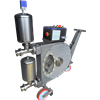
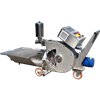
Peristaltic Pumps for Must
Peristaltic Pumps are generally considered to be the “best” of all pumps. Inside a sealed, semi-circular case, a flexible tube is routed from an inlet port directly to an outlet port, making a U-shape, so that the two ports line up vertically. A rotor with two (or more) rollers turns on a central axis. As the rotor turns in the case, the wheels roll over the tube. Each roller compresses (occludes) the tube, creating a sealed pocket of product. As the roller moves forward, that pocket is pushed toward the outlet; when the roller releases, the tube reopens and draws more product in behind it. No force is placed on the product being transferred through the tube—vacuum pressure draws the product in and positive displacement carries it through to the outlet; making peristaltic pumps extremely gentle.
Larger peristaltic pumps often have “compensation chambers” at the ports. These fill with product and will “back fill” the inner tube as it empties, creating a continuous flow (without them, the flow pulsates). Peristaltic pumps have a reversible flow direction and there is zero risk of damage if run dry. Because of the lack of stress and friction, parts rarely need to be replaced. Peristaltic pumps are also extremely sanitary due to there not being any internal components between the inlet and outlet ports where bacteria can build up.