Presses
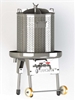
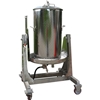
Pressing usually takes place anywhere from immediately after destemming and crushing (white wines), to a few hours after (rosés), to days or weeks down the road (red wines). There is a myriad of different kinds of presses that can be used to make wine, each having aspects or features that make it better suited for certain applications; however, the two types of presses that are the most widely used are Basket ("Traditional" and “Vertical Hydraulic”) and Membrane ("Bladder" and "Horizontal Pneumatic").
Though these two styles of presses couldn’t be more different in their approach to pressing, both produce high quality white, rosé, and red wine due to their versatility.
Pressing
Basket Presses
Whether it’s a centuries-old ratchet press, or it’s a brand new, fully automated, multi-stage vertical hydraulic press; the operating principle remains the same: a single surface (press plate) applies pressure downward on a basket full of crushed fruit to extract juice. And, while this style of press has been used for thousands of years to produce every conceivable type of wine (archeologists have unearthed basket presses dating back to pre-1st millennium BC), it really shines is in the production of bold, aromatic, flavorful, red wine.
As the pressure of the press plate increases, the wine that is extracted flows down through layers of grape skin and pulp, absorbing the color, flavor, and aromatics as it makes its way to the drain basin. There’s also a much larger range of pressure that can be applied than any other style of press, giving the user the ability to really fine-tune the pressing process.
Basket presses are more than capable of producing high-quality white wine as well. Winemakers will often stagger some sort of semi-permeable material, such as dripping diaphragms, between layers of must. These act as a sort of buffer in that, as soon as the extracted juice reaches the diaphragm it flows outward to the exterior of the basket, reducing its interaction with grape skins and pulp, resulting in a lighter and crisper juice.
Membrane Presses
Membrane pressing is a relatively new process, having been patented only in the 1950’s. Unlike previous press designs that rely on high pressure from a relatively small pressing surface, a membrane (or “bladder”) is a large, expanding surface that forces must outward to the inner edges of the basket, rather than downward to the basin. This reduces the amount of pulp and skins that the wine travels through and requires significantly less pressure than other pressing methods with similar yields. The result is a fresher and cleaner juice, ideal for making white wine.
So, how do you get high-quality red wine from a membrane press?
Simple. Larger pneumatic membrane presses have a horizontal drum, rather than the vertical perforated cage of the smaller bladder presses. Within the drum, there are limited drain channels, typically with ports that can be opened and closed as desired. Between pressing cycles, the drum rotates clockwise and counterclockwise, allowing the extracted wine to mix with the pulp and skins before it is drained from the press.

Basket Presses
Whether it’s a centuries-old ratchet press, or it’s a brand new, fully automated, multi-stage vertical hydraulic press; the operating principle remains the same: a single surface (press plate) applies pressure downward on a basket full of crushed fruit to extract juice. And, while this style of press has been used for thousands of years to produce every conceivable type of wine (archeologists have unearthed basket presses dating back to pre-1st millennium BC), it really shines is in the production of bold, aromatic, flavorful, red wine.
As the pressure of the press plate increases, the wine that is extracted flows down through layers of grape skin and pulp, absorbing the color, flavor, and aromatics as it makes its way to the drain basin. There’s also a much larger range of pressure that can be applied than any other style of press, giving the user the ability to really fine-tune the pressing process.
Basket presses are more than capable of producing high-quality white wine as well. Winemakers will often stagger some sort of semi-permeable material, such as dripping diaphragms, between layers of must. These act as a sort of buffer in that, as soon as the extracted juice reaches the diaphragm it flows outward to the exterior of the basket, reducing its interaction with grape skins and pulp, resulting in a lighter and crisper juice.
Membrane Presses
Membrane pressing is a relatively new process, having been patented only in the 1950’s. Unlike previous press designs that rely on high pressure from a relatively small pressing surface, a membrane (or “bladder”) is a large, expanding surface that forces must outward to the inner edges of the basket, rather than downward to the basin. This reduces the amount of pulp and skins that the wine travels through and requires significantly less pressure than other pressing methods with similar yields. The result is a fresher and cleaner juice, ideal for making white wine.
So, how do you get high-quality red wine from a membrane press?
Simple. Larger pneumatic membrane presses have a horizontal drum, rather than the vertical perforated cage of the smaller bladder presses. Within the drum, there are limited drain channels, typically with ports that can be opened and closed as desired. Between pressing cycles, the drum rotates clockwise and counterclockwise, allowing the extracted wine to mix with the pulp and skins before it is drained from the press.