

Fluid Transfer Pump
Fluid transfer pumps are intended for pumping liquids or liquids with some small amounts of sediment. These pumps tend to have smaller internal components (pump heads, impellers, etc.) as well as smaller inlet and outlet ports. Some fluid pumps, like the compact screw pump and single-speed peristaltic pump, can transfer viscous material as well as fluids with sediment.
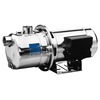
Pump Styles - Details and Features
Solid Impeller Pumps
Almost all Solid Impeller Pumps are “Centrifugal Pumps”. Accordingly, almost all Solid Impeller Pumps are intended for transferring fluids only. A centrifugal pump uses an internal turbine (Impeller) to pull fluid in at the center and spins it outward at a higher speed / pressure using centrifugal force. Traditionally, a centrifugal pump would have a dedicated inlet port and outlet port, and the inlet would be positioned directly at the center of the head (and at the center of the impeller). Modern centrifugal pumps have heads that employ a combination of small channels and chambers that allow the ports to be at any position while still having the inflow go to the center of the impeller, while the outflow comes from the exterior of the impeller. This also enables either port to be used as the inlet or outlet.
The benefits of solid impeller pumps are that they are relatively inexpensive and extremely durable. The drawbacks are that they are not gentle on the product that is being pumped, are highly susceptible to damage if run dry (without priming the head before use), and are intended only for transferring fluids—the exception being solid impeller pumps on Destemmers (such as the Zambelli “Gamma” series).
Solid Impeller Pumps
Almost all Solid Impeller Pumps are “Centrifugal Pumps”. Accordingly, almost all Solid Impeller Pumps are intended for transferring fluids only. A centrifugal pump uses an internal turbine (Impeller) to pull fluid in at the center and spins it outward at a higher speed / pressure using centrifugal force. Traditionally, a centrifugal pump would have a dedicated inlet port and outlet port, and the inlet would be positioned directly at the center of the head (and at the center of the impeller). Modern centrifugal pumps have heads that employ a combination of small channels and chambers that allow the ports to be at any position while still having the inflow go to the center of the impeller, while the outflow comes from the exterior of the impeller. This also enables either port to be used as the inlet or outlet.
The benefits of solid impeller pumps are that they are relatively inexpensive and extremely durable. The drawbacks are that they are not gentle on the product that is being pumped, are highly susceptible to damage if run dry (without priming the head before use), and are intended only for transferring fluids—the exception being solid impeller pumps on Destemmers (such as the Zambelli “Gamma” series).
Flexible Impeller Pumps
Flexible Impeller Pumps are often referred to as the “workhorse” of pumps. They’re inexpensive compared to similarly capable pumps, long lasting (when properly cared for), and parts are easily replaceable and readily available. The pump uses circular impeller made of an elastomer (usually NBR, silicone, or EPDM) with flexible vanes inside a tightfitting pump head. Typically, the bottom half of the internal cavity is circular with a radius that matches the impeller, and a top half that is somewhat “flattened”, resulting in the flexible vanes folding and unfolding as they pass through the upper portion of the pump head during the impeller’s rotation. This generates a vacuum at the inlet port and positive displacement at the outlet, providing a gentler product flow when combined with the kinetic energy produced by the rotation of the impeller. Increasing the size of the pump head and impeller [along with the motor and other mechanical components] not only increases the maximum flowrate of the pump, but results in the ability to transfer must (solids and liquids) due to the larger space between the vanes within the pump head.
The downside to Flexible Impeller Pumps is that, like solid centrifugal impeller pumps, they still use kinetic energy to force the product around the pump head, and the pump head must always be primed when operating to prevent damage from dry running.
Flexible Impeller Pumps are often referred to as the “workhorse” of pumps. They’re inexpensive compared to similarly capable pumps, long lasting (when properly cared for), and parts are easily replaceable and readily available. The pump uses circular impeller made of an elastomer (usually NBR, silicone, or EPDM) with flexible vanes inside a tightfitting pump head. Typically, the bottom half of the internal cavity is circular with a radius that matches the impeller, and a top half that is somewhat “flattened”, resulting in the flexible vanes folding and unfolding as they pass through the upper portion of the pump head during the impeller’s rotation. This generates a vacuum at the inlet port and positive displacement at the outlet, providing a gentler product flow when combined with the kinetic energy produced by the rotation of the impeller. Increasing the size of the pump head and impeller [along with the motor and other mechanical components] not only increases the maximum flowrate of the pump, but results in the ability to transfer must (solids and liquids) due to the larger space between the vanes within the pump head.
The downside to Flexible Impeller Pumps is that, like solid centrifugal impeller pumps, they still use kinetic energy to force the product around the pump head, and the pump head must always be primed when operating to prevent damage from dry running.
Peristaltic Pumps
Peristaltic Pumps are generally considered to be the “best” of all pumps. Inside a sealed, semi-circular case, a flexible tube is routed from an inlet port directly to an outlet port, making a U-shape, so that the two ports line up vertically. A rotor with two (or more) rollers turns on a central axis. As the rotor turns in the case, the wheels roll over the tube. Each roller compresses (occludes) the tube, creating a sealed pocket of product. As the roller moves forward, that pocket is pushed toward the outlet; when the roller releases, the tube reopens and draws more product in behind it. No force is placed on the product being transferred through the tube—vacuum pressure draws the product in and positive displacement carries it through to the outlet; making peristaltic pumps extremely gentle.
Larger peristaltic pumps often have “compensation chambers” at the ports. These fill with product and will “back fill” the inner tube as it empties, creating a continuous flow (without them, the flow pulsates). Peristaltic pumps have a reversible flow direction and there is zero risk of damage if run dry. Because of the lack of stress and friction, parts rarely need to be replaced. Peristaltic pumps are also extremely sanitary due to there not being any internal components between the inlet and outlet ports where bacteria can build up.
Peristaltic Pumps are generally considered to be the “best” of all pumps. Inside a sealed, semi-circular case, a flexible tube is routed from an inlet port directly to an outlet port, making a U-shape, so that the two ports line up vertically. A rotor with two (or more) rollers turns on a central axis. As the rotor turns in the case, the wheels roll over the tube. Each roller compresses (occludes) the tube, creating a sealed pocket of product. As the roller moves forward, that pocket is pushed toward the outlet; when the roller releases, the tube reopens and draws more product in behind it. No force is placed on the product being transferred through the tube—vacuum pressure draws the product in and positive displacement carries it through to the outlet; making peristaltic pumps extremely gentle.
Larger peristaltic pumps often have “compensation chambers” at the ports. These fill with product and will “back fill” the inner tube as it empties, creating a continuous flow (without them, the flow pulsates). Peristaltic pumps have a reversible flow direction and there is zero risk of damage if run dry. Because of the lack of stress and friction, parts rarely need to be replaced. Peristaltic pumps are also extremely sanitary due to there not being any internal components between the inlet and outlet ports where bacteria can build up.
Screw Pumps
Mohno Pumps are a particular style of screw pump, classified as “progressive cavity pumps”, that are ideal for the food and beverage industry. Rather than a screw or auger that spins on a fixed center axis, mohno pumps use a central helical rotor (think of a spring that has been stretched out by pulling at both ends) that spins within a stator—an internal chamber that has double-helix channels running from one end to the other. The result is a series of cavities that run from the pump’s inlet to its outlet, that generate suction to pull product through, never changing in size or shape the entire way.
Progressive cavity pumps are particularly great at handling viscous, abrasive, and particle-laden fluid. With a bypass system, they can handle high pressure without risk of damage to seals, making this type of pump excellent for transferring product longer distances. Wear and tear on the internal stator require it to be replaced more frequently than parts on other pumps (highly dependent on usage and care).
Mohno Pumps are a particular style of screw pump, classified as “progressive cavity pumps”, that are ideal for the food and beverage industry. Rather than a screw or auger that spins on a fixed center axis, mohno pumps use a central helical rotor (think of a spring that has been stretched out by pulling at both ends) that spins within a stator—an internal chamber that has double-helix channels running from one end to the other. The result is a series of cavities that run from the pump’s inlet to its outlet, that generate suction to pull product through, never changing in size or shape the entire way.
Progressive cavity pumps are particularly great at handling viscous, abrasive, and particle-laden fluid. With a bypass system, they can handle high pressure without risk of damage to seals, making this type of pump excellent for transferring product longer distances. Wear and tear on the internal stator require it to be replaced more frequently than parts on other pumps (highly dependent on usage and care).
Diaphragm Pumps
Most diaphragm pumps used for handling beverages are air-operated double diaphragm (AODD) pumps. These pumps contain two chambers (diaphragms) made of flexible material, with a central piston between them. An external source of compressed air controls the speed that the piston moves back and forth. As the piston moves in one direction, it forces one of the diaphragms to expand and the other to contract. The expanding diaphragm pulls product into it, while the contracting diaphragm is squeezing product out. When the piston slides in the other direction, the diaphragms switch functions.
AODD pumps do not have an onboard motor or gearbox. Accordingly, they are often manufactured of thermoplastic, making them lightweight and low cost. They are extremely gentle on product and have a variable flowrate that can be controlled by adjusting the air pressure going into them. Because these pumps do require an external source of air to operate, they are usually used indoors where air compressors or central air supply are readily available. You’ll typically find them used with cartridge filter systems (often mounted on carts with the filter housings) for final stage / pre-bottling filtration.
Most diaphragm pumps used for handling beverages are air-operated double diaphragm (AODD) pumps. These pumps contain two chambers (diaphragms) made of flexible material, with a central piston between them. An external source of compressed air controls the speed that the piston moves back and forth. As the piston moves in one direction, it forces one of the diaphragms to expand and the other to contract. The expanding diaphragm pulls product into it, while the contracting diaphragm is squeezing product out. When the piston slides in the other direction, the diaphragms switch functions.
AODD pumps do not have an onboard motor or gearbox. Accordingly, they are often manufactured of thermoplastic, making them lightweight and low cost. They are extremely gentle on product and have a variable flowrate that can be controlled by adjusting the air pressure going into them. Because these pumps do require an external source of air to operate, they are usually used indoors where air compressors or central air supply are readily available. You’ll typically find them used with cartridge filter systems (often mounted on carts with the filter housings) for final stage / pre-bottling filtration.
